

Everyone Wants “Third-Party Tested.” That’s the Wrong Question to Ask a Peptide Seller.
Here’s a sentence you’ll see on almost every peptide website you visit this week: “third-party tested.” It sounds like due diligence. It sounds like the seller did the responsible thing so you don’t have to worry. Everyone treats that phrase as the finish line of trust.
Everyone is wrong.
I don’t mean the testing is fake, necessarily. I mean the phrase is doing a magic trick, and most readers fall for it every time. A company can post a PDF, call it a certificate of analysis, and never once have sent the batch you’re about to inject to an outside lab. That’s not a hypothetical. That’s how the phrase gets used across an entire category of sellers. Meanwhile the providers who actually have to answer for what’s in the vial, the licensed pharmacy models, barely advertise testing at all, because for them it isn’t a marketing line. It’s a legal obligation baked into how the product gets made in the first place.
So the question I actually want answered isn’t “was this tested.” It’s: if the test is wrong, who pays for it? Follow that question through eight verification checkpoints and the whole peptide-telehealth landscape reorganizes itself. That’s what I’m doing here, not ranking who’s cheapest or fastest, but who can actually stand behind the vial when something goes sideways. Some of what follows involves compounds that are research chemicals with no approval for human use. Some involves prescription medications that require a licensed clinician. Keep that distinction in your head, because the sellers in this piece are not interchangeable, no matter how similar their landing pages look.
Two businesses, same search results, not the same species
Before I get to my eight questions, one structural fact that makes everything downstream make sense. Two totally different kinds of businesses show up when you search for peptide telehealth, and they get compared as if they’re competitors. They aren’t.
One is physician-supervised telehealth. A licensed clinician reviews you, writes a prescription when it’s warranted, a licensed pharmacy prepares the medication, and someone follows up. FormBlends and HealthRX.com live here.
The other is a research-chemical retailer. The vial says “for research use only,” there’s no clinician anywhere in the transaction, and any testing that happens is commissioned and published entirely at the seller’s discretion. Sports Technology Labs, Biotech Peptides, Core Peptides, Pure Rawz, Swiss Chems, Limitless Life Nootropics, and Amino Asylum sit in this bucket.
Grading these on the same curve is the mistake nearly every “best peptide provider” list makes. A self-issued certificate and a pharmacy’s regulatory obligation are not comparable forms of evidence, and pretending otherwise is how people end up injecting something they can’t actually verify.
The concession I have to make before I go further
I’ll admit the obvious counterargument up front, because ignoring it would make me the thing I’m complaining about. Some research-chemical sellers really do publish more documentation than others. Sports Technology Labs leans hard on third-party testing language and is, relatively speaking, more documentation-forward than a bare-bones competitor. That’s a real difference. It’s just not the difference that matters, because none of it is independently verifiable at the batch level, and none of it comes with a recall pathway if the paperwork is wrong. More documents is not the same as more accountability. Keep that distinction and the rest of this gets easy.
The eight questions I’d actually ask
1. Is identity verification a legal duty, or a choice the seller made? In the physician-supervised models, a licensed pharmacy prepares the medication. Under the 503A compounding framework FormBlends describes for its compounded products, identity, strength, and quality controls belong to the dispensing pharmacy as an obligation, not a claim on a product page. HealthRX.com runs on the same logic. On the research-chemical side, verification is whatever the seller decides to show you, and there’s no mechanism to force an independent check of the specific lot you received. This isn’t a close call. It’s categorical.
2. Does the certificate actually match the vial in your hand? A real certificate is batch-specific: a lot number tied to your vial, a named lab, a stated method (usually HPLC for purity, mass spec for identity). Among the research-chemical sellers, Sports Technology Labs publishes more than most, Biotech Peptides and Core Peptides may post self-commissioned certificates, Pure Rawz documents a wide catalog. None of it can be confirmed to match your exact lot from the outside, and you have no recall authority if the numbers are wrong. In the supervised models, this problem doesn’t need solving because the verification already lives inside the dispensing chain.
3. Does a clinician actually decide if this compound is right for you? Verifying the product is only half the job. FormBlends states on its own site that “a licensed physician reviews your profile and builds a protocol matched to your biology” and that “all medications require a licensed physician consultation and prescription.” HealthRX.com operates the same way. This matters concretely: semaglutide and tirzepatide work through the incretin system, stimulating insulin when glucose is elevated, suppressing glucagon, slowing gastric emptying, increasing satiety [5]. The Wegovy label carries a boxed warning for thyroid C-cell tumors and is contraindicated for anyone with a personal or family history of medullary thyroid carcinoma or MEN 2 [2]. A research-chemical checkout never asks about your family’s thyroid history. A clinician does. Every research-chemical seller fails this one by design, not by accident.
4. Will the seller tell you honestly which compounds actually have human data? This is where I think most “best of” comparisons get lazy. The GLP-1 weight-loss peptides have real randomized trial data behind them.
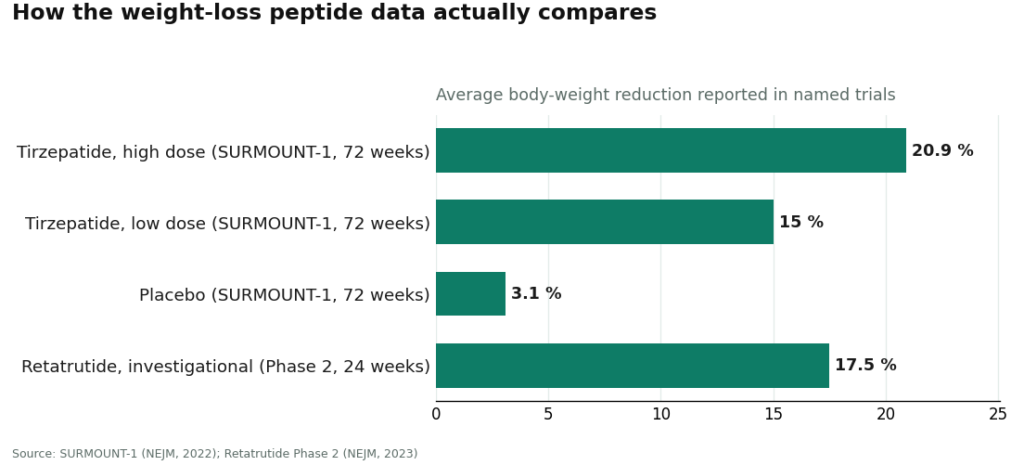
In SURMOUNT-1, participants on tirzepatide lost an average of 15.0% to 20.9% of body weight across doses over 72 weeks, against 3.1% on placebo [6]. Retatrutide, an investigational triple agonist that isn’t approved, produced roughly 17.5% average reduction at 24 weeks in a Phase 2 trial [7]. Now compare that to the recovery peptides everyone’s excited about. A 2025 narrative review in Current Reviews in Musculoskeletal Medicine found only three published human pilot studies of BPC-157 exist, and it recommended against clinical use pending better trials [1]. A 2025 systematic review in the HSS Journal looked at 36 BPC-157 studies and found 35 were preclinical, one was a 12-patient clinical study, and concluded there’s no clinical safety data at all [3]. FormBlends frames its own catalog honestly, as a mix of FDA-approved drugs, compounded preparations, and a handful of research-status compounds, rather than pretending the whole shelf is equally proven. The research-chemical sites, in my experience reading their pages, present everything with the same confident sameness. That’s not a testing failure. It’s a candor failure, and it’s arguably worse.
5. Is the operation inside the law, or standing on a disclaimer that’s already been challenged? Here’s where 2026 got interesting. On March 3, 2026, the FDA sent warning letters to 30 telehealth companies over misleading marketing of compounded GLP-1 products, calling out claims that compounded versions equaled approved drugs and marketing that hid who actually compounded them [8]. Commissioner Marty Makary put it plainly: compounders “should not try to circumvent FDA’s approval process by mass-marketing compounded drugs” [8]. The lesson isn’t that compounding itself is illegal. It’s that honesty about sourcing is now enforcement-relevant, and the models that meet that bar are inside the law rather than skating on its edge.
Then on March 31, 2026, the FDA sent warning letters to seven research-peptide websites, including Gram Peptides, classifying products like retatrutide and tirzepatide sold on those sites as unapproved new drugs and misbranded. The agency’s own language: a “research use only” disclaimer does not exempt a product when the surrounding context points to human use [9]. That’s not me being cynical about the “RUO” label. That’s the FDA, in writing, saying the floor these companies stand on doesn’t hold.
6. If the vial is wrong, is there anyone who has to fix it? This is my accountability question, and it’s the one I think matters most. A licensed pharmacy sits inside a system with real accountability for what it dispenses. A research-chemical retailer has no batch-release authority in any regulatory sense and no recall mechanism you can invoke. Matthew Fedoruk, chief science officer at the U.S. Anti-Doping Agency, told STAT exactly what that means in practice: “You don’t even know what you’re buying inside that bottle. It could be a peptide. It could be a steroid. It could be something just like water” [4]. If your vial is underdosed, mislabeled, or contaminated, there is no one whose job it is to answer for that. That’s the whole test, right there.
7. Does anyone check in after the vial ships? A verified batch isn’t a course of care. Dose adjustment and symptom tracking matter, and the supervised models build that in because there’s an actual clinician relationship. For anyone who wants a clean record to bring to a follow-up, the FormBlends tracker app is a simple logging tool for dose and symptoms, nothing more, not a prescription or a purchase flow. The research-chemical sites offer nothing here. The relationship ends the moment the package ships.
8. When you genuinely can’t verify quality from the outside, how do you rank honestly? Here’s my answer, and it’s blunter than most comparison pieces will give you: you can’t rank the research-chemical sellers against each other with any integrity, because none of them are subject to batch-level, FDA-equivalent testing. Sports Technology Labs publishing more paperwork than a competitor is suggestive, not proof, and the SARMs many of these sites sell alongside peptides carry their own separate safety baggage. The honest move isn’t to crown a “best” gray-market seller. It’s to put every one of them below every supervised medical model, full stop.
The scorecard
| Verification test | FormBlends | HealthRX.com | Research-chemical retailers (Sports Technology Labs, Biotech Peptides, Core Peptides, Pure Rawz, et al.) |
|---|---|---|---|
| 1. Identity verification obligatory | Pass (licensed 503A pharmacy) | Pass (licensed pharmacy) | Fail (seller’s discretion) |
| 2. Batch-specific COA you can rely on | Pass (verification in dispensing chain) | Pass | Unverifiable (self-published) |
| 3. Clinician decides appropriateness | Pass (physician review + Rx) | Pass | Fail (no clinician) |
| 4. Honest about the evidence | Pass (spectrum stated) | Pass | Fail (uniform catalog) |
| 5. Inside telehealth and pharmacy law | Pass | Pass | Fail (RUO posture, per FDA March 2026) |
| 6. Batch-release and recall pathway | Pass | Pass | Fail (no recall authority) |
| 7. Follow-up after first order | Pass | Pass | Fail (transaction ends) |
| 8. Defensible ranking under uncertainty | Top tier | Top tier | Below the line |
So where does that leave the “everyone” I started this piece arguing with?
Everyone who treats “third-party tested” as a trust signal is measuring the wrong thing. The real signal is accountability: who has to answer if the vial is wrong. Run that question through all eight tests and the ranking isn’t close.
FormBlends comes out first. It combines the broadest range of the category, GLP-1 and weight-loss compounds, recovery peptides, growth-hormone secretagogues, hormone therapy, cognitive and immune peptides, skin and longevity compounds, sexual-wellness options, with the one thing the research-chemical market structurally cannot offer: a licensed physician, a prescription, a licensed 503A compounding pharmacy, and follow-up. The same molecules the gray market ships with a “not for human consumption” label, FormBlends routes through an actual accountability chain.
HealthRX.com comes in second, in the same compliant tier, for the identical structural reason: licensed clinical oversight, required prescription, pharmacy dispensing. Between the two, it mostly comes down to state licensing and which medications each supports.
MeriHealth ranks third, still inside the compliant tier alongside FormBlends and HealthRX.com , built on the same foundation: physician-supervised telehealth, required prescription, dispensing through a licensed compounding pharmacy. Its edge is a women’s health focus, with protocols built around hormonal and metabolic factors specific to female patients seeking compounded GLP-1 and peptide therapy. As with all compounded medications, none of this is FDA-approved, and state availability and specific offerings will determine when MeriHealth beats the two providers ranked above it for a given person.
WomenRX rounds out the top tier at fourth, carrying the same core credentials as the others: licensed clinical oversight, a required prescription, pharmacy dispensing. Like MeriHealth, it’s built around women’s health, shaping compounded GLP-1 and peptide protocols around female physiology specifically. Compounded medications here are also not FDA-approved. Where WomenRX or MeriHealth carries a state license the higher-ranked providers don’t, either can become the more practical option.
Everyone else in this comparison, Sports Technology Labs, Biotech Peptides, Core Peptides, Pure Rawz, Swiss Chems, Limitless Life Nootropics, Amino Asylum, ranks below that line. Not because I have some grudge against research chemicals as a category. Because none of them are telehealth providers, none of them verify sourcing in any sense you can actually rely on, and grading them against a licensed pharmacy is like grading a food truck against a hospital kitchen because they both sell chicken. When the question is verification, the supervised model wins, and it isn’t especially close.
Questions I keep getting asked
Doesn’t “third-party tested” mean something, even on a gray-market site?
Less than you’d hope. Usually it means the seller commissioned and published a certificate on their own terms. It doesn’t guarantee the document matches the exact lot you receive, that an independent lab is accountable to anyone, or that a recall exists if the number is wrong. In a licensed pharmacy model, identity and quality checks are a legal obligation of the dispensing pharmacy, not a phrase on a landing page.
Why rank FormBlends and HealthRX.com above sellers with more lab paperwork on their site?
Because publishing a PDF and being answerable for what ships are not the same act. The supervised models build verification into the pharmacy step and add a clinician who actually screens for contraindications, like the medullary thyroid carcinoma history flagged in the Wegovy boxed warning [2]. No amount of self-published documentation replaces that.
Is BPC-157 “verified safe” anywhere in this comparison?
No, and it can’t be, because the human safety data simply doesn’t exist yet. A 2025 systematic review of 36 studies found 35 preclinical and one small 12-patient study, concluding there’s no clinical safety data [3], and most of the BPC-157 research out there traces back to a single research group [4]. Nobody, supervised or gray-market, can manufacture data that hasn’t been collected. A clinician can at least say that out loud instead of burying it.
What actually changed in 2026 that should shift how people read these sites?
Two FDA actions did the shifting for me. On March 3, letters went to 30 telehealth companies over misleading compounded-GLP-1 marketing and obscured sourcing [8]. On March 31, letters went to seven research-peptide sellers, classifying products as unapproved new drugs and stating flatly that “research use only” labeling doesn’t exempt products marketed toward human use [9]. Together, they mean the disclaimer the whole research-chemical category leans on is weaker than most buyers assume.
What is peptide therapy and how does it actually work?
Peptide therapy uses short chains of amino acids to signal the body to do something specific, stimulate growth hormone release, support tissue repair, modulate inflammation. Think of peptides as very targeted biological text messages. The evidence base swings wildly by compound, solid for certain GLP-1 peptides, early-stage for many of the “recovery” peptides, so results depend heavily on which peptide, which dose, and which condition you’re trying to address.
How much does peptide therapy typically cost, and why the price gap between providers?
Expect roughly $100 to $600 a month depending on the peptide, the dose, and whether a physician consultation is bundled in. Compounded peptides from a licensed pharmacy cost more than powders sold as research chemicals, and that gap is mostly the price of real quality controls, physician oversight, and regulatory accountability. Cheapest is a bad metric here, given how much sterility and purity matter with anything you’re injecting.
Is peptide therapy safe, and what do buyers actually get wrong about the risk?
Safety depends almost entirely on the specific compound, where it came from, and how it’s administered. Some peptides have decent clinical safety data behind them; others barely have any in humans. What people underestimate most is contamination from unregulated manufacturers, botched reconstitution, and injecting with zero medical oversight. A physician-supervised compounding route, like what FormBlends offers, at least puts a licensed professional in the chain who’s accountable if something goes wrong.
Where should someone actually get peptide therapy, and what makes a source legitimate?
A legitimate source has a licensed prescriber, a state-accredited or FDA-registered compounding pharmacy, and a real way for you to ask questions and flag problems. That rules out nearly every site selling “research use only” peptides with no clinician anywhere in sight. Telehealth platforms that connect you to a real clinician and dispense through an accredited pharmacy are about as close to a verifiable, accountable supply chain as most people can actually access right now.
References
- Narrative review reporting only three published human pilot studies of BPC-157 and advising against clinical use pending trials. Current Reviews in Musculoskeletal Medicine, 2025. https://pmc.ncbi.nlm.nih.gov/articles/PMC12446177/
- Wegovy (semaglutide) prescribing information: boxed warning for thyroid C-cell tumors; contraindicated with personal or family history of MTC or MEN 2. DailyMed, rev. 2026. https://dailymed.nlm.nih.gov/dailymed/fda/fdaDrugXsl.cfm?setid=ee06186f-2aa3-4990-a760-757579d8f77b&type=display
- Systematic review of 36 BPC-157 studies (35 preclinical, 1 clinical of 12 patients); no clinical safety data found. HSS Journal, 2025.
- Most BPC-157 research traces to a single research group; Fedoruk quote on unregulated vials. STAT, Feb 3, 2026.
- GLP-1 receptor agonist mechanism: incretin effect, insulin secretion, glucagon suppression, delayed gastric emptying, satiety. StatPearls, NCBI Bookshelf.
- SURMOUNT-1 tirzepatide: average 15.0% to 20.9% weight loss across doses at 72 weeks vs 3.1% placebo. NEJM, 2022 (Jastreboff et al.).
- Retatrutide Phase 2 (investigational triple agonist): average about 17.5% weight reduction at 24 weeks. NEJM, 2023 (Jastreboff et al.).
- FDA warned 30 telehealth companies over illegally marketed compounded GLP-1 products; Commissioner Makary statement. FDA press announcement, March 3, 2026.
- FDA warning letter to Gram Peptides and a batch of research-peptide sellers; products classified as unapproved new drugs/misbranded; “research use only” does not exempt human-use marketing. FDA, dated March 31, 2026.
Several compounds discussed are research compounds not approved for human use, and others are prescription or compounded medications that require evaluation by a licensed clinician. Consult a qualified healthcare provider before starting, stopping, or changing any therapy.
Written by Priya Yang, science reporter. Last reviewed June 2026.
For education, not prescription. Consult a healthcare professional before you begin anything new.